
Table of Contents
ToggleGhost of Tsushima is an action-adventure video game developed by Sucker Punch Productions. Sony Interactive Entertainment published the game in July 2020 for PlayStation 4. The title quickly became one of the most acclaimed games of its generation, selling over 13 million copies by 2024.
Players take on the role of Jin Sakai, a samurai warrior defending his homeland during the first Mongol invasion of Japan. The game blends historical fiction with open-world exploration, stealth mechanics, and intense sword combat. Ghost of Tsushima stands out for its stunning visual design, emotional storytelling, and deep respect for Japanese culture and cinema.
This article covers everything players need to know about Ghost of Tsushima. It explores the game’s setting, story, gameplay systems, and available platforms.
Key Takeaways
- Ghost of Tsushima is an action-adventure game by Sucker Punch Productions set during the 1274 Mongol invasion of Japan, selling over 13 million copies.
- Players control Jin Sakai, a samurai who must choose between traditional honor and guerrilla tactics to save Tsushima Island.
- The combat system features four switchable stances and stealth options, allowing players to fight as a noble samurai or strike as “The Ghost.”
- Ghost of Tsushima is available on PlayStation 4, PlayStation 5, and PC, with the Director’s Cut including the Iki Island expansion.
- The free Legends multiplayer mode offers cooperative missions with four unique character classes for up to four players.
Setting and Historical Background
Ghost of Tsushima takes place on Tsushima Island in 1274. This real Japanese island sits in the strait between Japan and Korea. The Mongol Empire, led by Khotun Khan, launches a massive invasion force to conquer Japan. Historical records confirm the Mongol invasion of Tsushima actually occurred during this period.
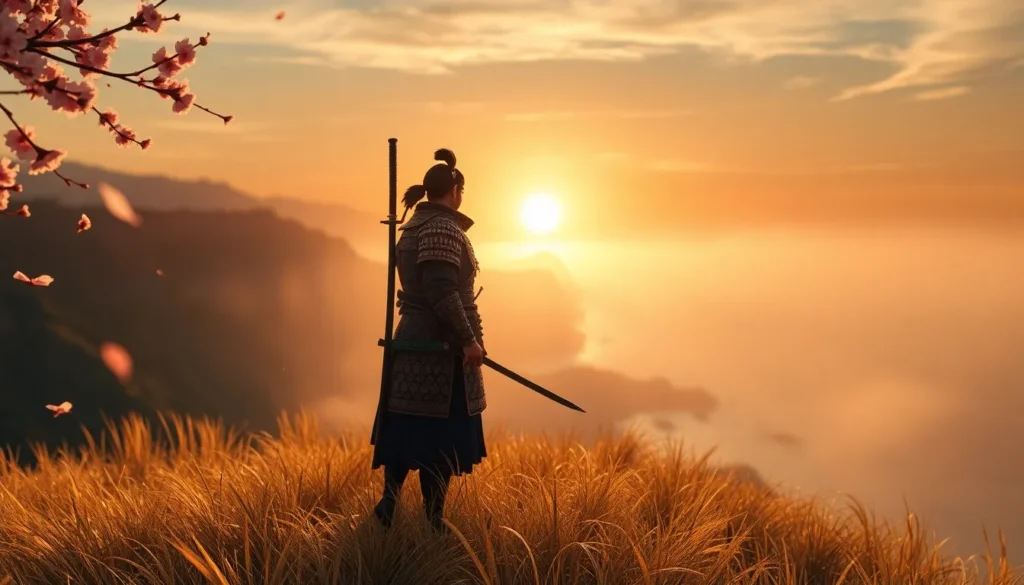
The game recreates feudal Japan with impressive detail. Players explore forests, grasslands, coastal cliffs, and mountain temples. Cherry blossom trees scatter petals across battlefields. Golden fields of pampas grass sway in the wind. Sucker Punch worked closely with Japanese cultural consultants to ensure authenticity.
Tsushima Island serves as more than a backdrop in Ghost of Tsushima. The environment plays an active role in gameplay. Wind guides players toward objectives. Foxes lead them to hidden shrines. Birds reveal secret locations. This design choice removes traditional waypoint markers and creates a more immersive experience.
The historical setting gives Ghost of Tsushima emotional weight. Real people lived and died defending this island. The game honors their sacrifice while telling a fictional story about honor, duty, and sacrifice.
Story and Main Characters
Ghost of Tsushima follows Jin Sakai, one of the last surviving samurai after the initial Mongol assault. Jin watched the invaders slaughter his fellow warriors at Komoda Beach. His uncle, Lord Shimura, was captured during the battle. Jin must rescue his uncle and push back the Mongol forces.
The story forces Jin to make difficult choices. Samurai follow a strict code of honor. They fight their enemies face-to-face. But the Mongols outnumber Jin’s forces dramatically. To save his people, Jin develops guerrilla tactics, poison, stealth kills, and terror. The local population begins calling him “The Ghost.”
This internal conflict drives Ghost of Tsushima’s narrative. Jin struggles between his samurai training and practical necessity. Lord Shimura represents traditional honor. He raised Jin and serves as the jito (lord) of Tsushima. Their relationship becomes complicated as Jin embraces dishonorable methods.
Khotun Khan serves as the primary antagonist. He’s a cunning military strategist who studies his enemies. The game portrays him as intelligent and ruthless rather than cartoonishly evil. He understands Japanese culture and uses that knowledge against the samurai.
Supporting characters add depth to the experience. Yuna, a thief, teaches Jin survival tactics. Sensei Ishikawa, a master archer, seeks a former student who betrayed him. Lady Masako, a warrior seeking vengeance for her murdered family, joins Jin’s cause. Each ally has their own story arc that players can pursue.
Gameplay and Combat System
Ghost of Tsushima offers two distinct combat approaches. Players can fight as a samurai or strike from the shadows like a ghost. Both styles feel satisfying and reward different playstyles.
The samurai combat system centers on stance switching. Jin learns four combat stances throughout the game. Stone Stance works best against swordsmen. Water Stance breaks through shields. Wind Stance counters spearmen. Moon Stance devastates brute enemies. Players must read enemy types and switch stances mid-battle. This keeps combat dynamic and strategic.
Ghost tactics offer alternative solutions. Jin can throw kunai, use smoke bombs, and assassinate enemies from behind. Poison darts incapacitate groups. Sticky bombs create chaos. These tools let players thin enemy numbers before direct confrontation.
Standoffs represent one of Ghost of Tsushima’s signature features. Jin can challenge enemies to one-on-one duels. Players must time their strike perfectly. A successful standoff kills the first enemy instantly and intimidates others. It captures the tension of classic samurai films.
Exploration rewards curiosity in Ghost of Tsushima. The open world contains hot springs that increase health. Bamboo strikes improve resolve (a resource for special abilities). Haiku locations let Jin compose poems. Fox dens lead to Inari shrines that expand charm slots. These activities feel organic rather than like checkbox tasks.
The game includes a Photo Mode that became extremely popular. Players can adjust weather, time of day, wind intensity, and particle effects. Many consider Ghost of Tsushima one of the most photogenic games ever made.
Available Platforms and Editions
Ghost of Tsushima launched exclusively on PlayStation 4 in July 2020. Sony released an expanded version called Ghost of Tsushima Director’s Cut in August 2021. This version added the Iki Island expansion, which features a new storyline and additional content.
The Director’s Cut is available on PlayStation 4, PlayStation 5, and PC. The PS5 version includes enhanced graphics, faster load times, haptic feedback, and adaptive trigger support. Players who own the PS4 version can upgrade to the Director’s Cut for a fee.
Ghost of Tsushima arrived on PC through Steam and Epic Games Store in May 2024. The PC version supports ultra-wide monitors, unlocked frame rates, and various graphical settings. It includes all Director’s Cut content.
Ghost of Tsushima Legends offers free multiplayer content. This cooperative mode lets up to four players tackle wave-based survival missions and story-driven chapters. Legends features its own progression system with four character classes: Samurai, Hunter, Ronin, and Assassin.
A standalone version of Legends is available for players who only want the multiplayer experience. This makes Ghost of Tsushima accessible at different price points depending on player preferences.


